Timothy McVeigh
Domestic terrorist who carried out the Oklahoma City bombing.

Thomas.R · CC BY-SA 4.0
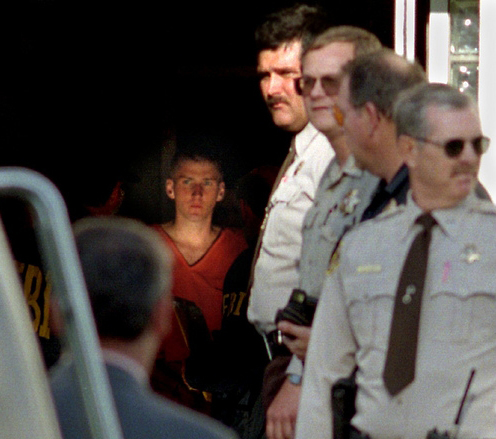
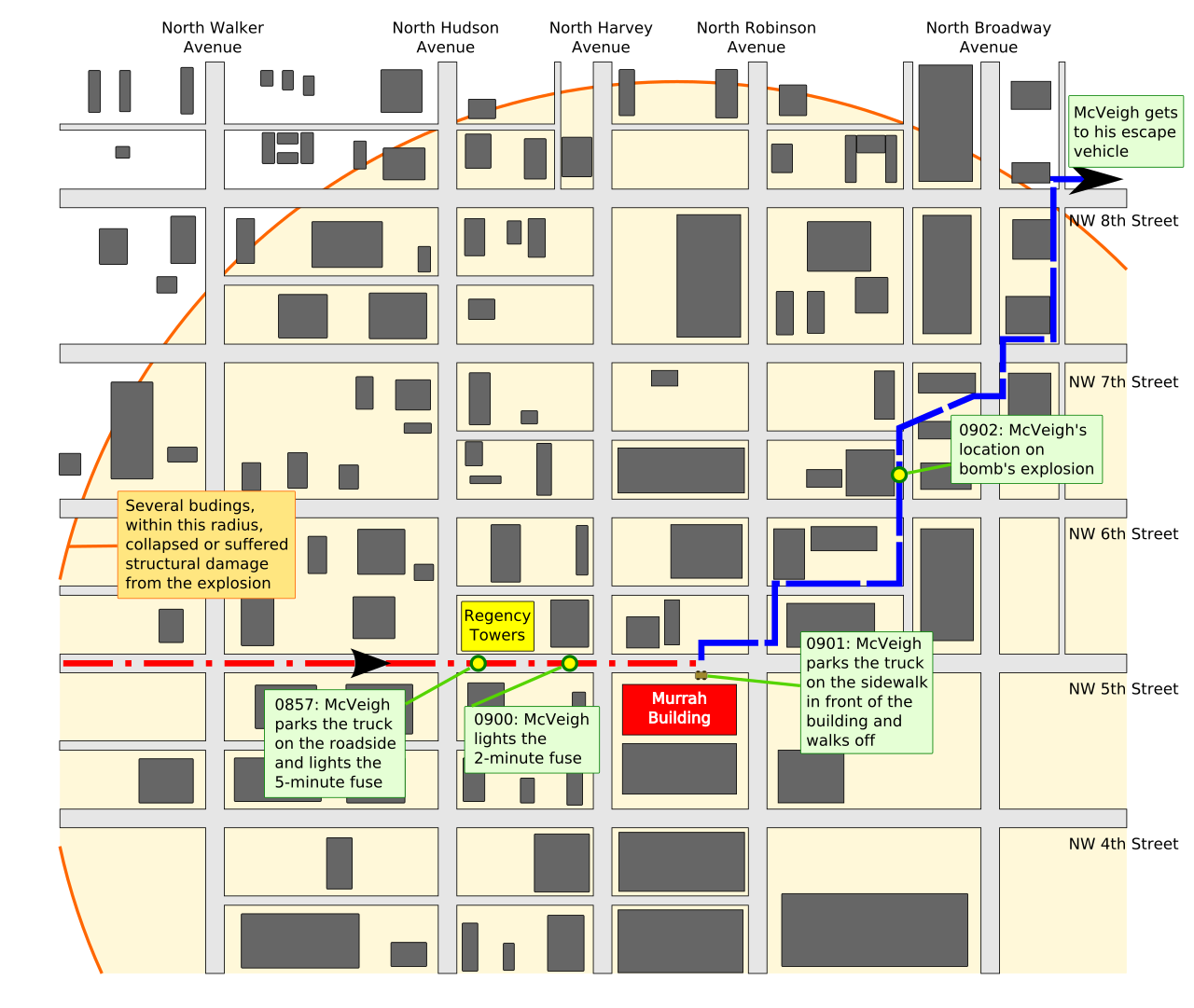
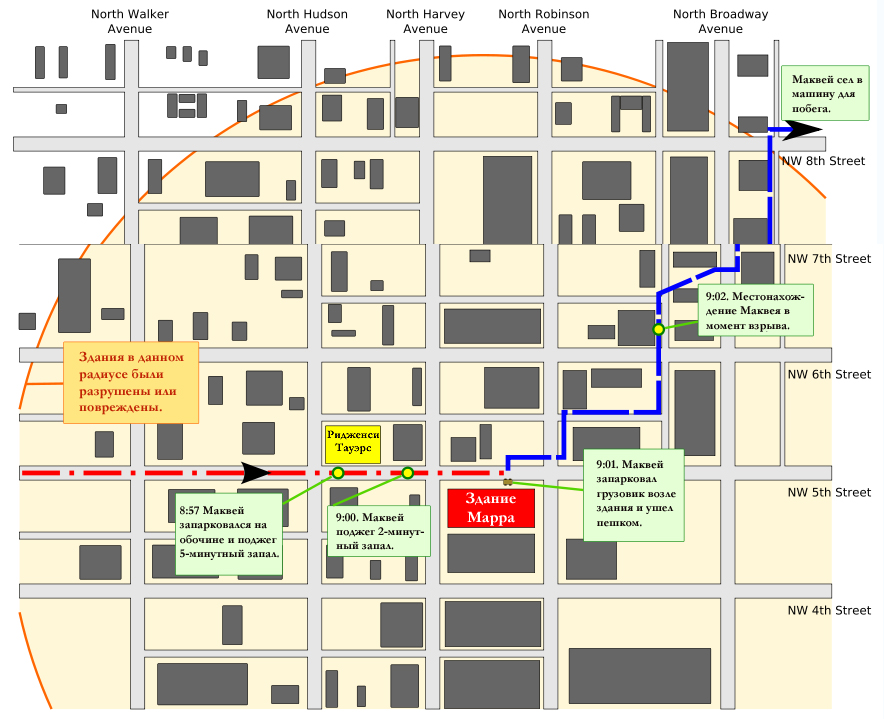
Timothy James McVeigh was an American domestic terrorist who masterminded and perpetrated the Oklahoma City bombing on April 19, 1995. The bombing itself killed 167 people (including 19 children), injured 684 people, and destroyed one-third of the Alfred P. Murrah Federal Building. A rescue worker was killed after the bombing when debris struck her head, bringing the total to 168 killed. It remains the deadliest act of domestic terrorism in U.S. history. A Gulf War veteran, McVeigh became radicalized by antigovernment beliefs. He sought revenge against the United States federal government for the 1993 Waco siege, as well as the 1992 Ruby Ridge incident. He was arrested shortly after the bombing and indicted on 160 state offenses and 11 federal offenses, including the use of a weapon of mass destruction. He was found guilty on all counts in 1997 and sentenced to death. McVeigh was executed by lethal injection on June 11, 2001, at the Federal Correctional Complex in Terre Haute, Indiana.
- born
- April 23, 1968, Lockport, New York
- died
- June 11, 2001, Terre Haute, Indiana
- field
- Domestic terrorism
- nationality
- American
- known_for
- Oklahoma City bombing
Verified Timeline
Lore & Background
Timothy James McVeigh was born on April 23, 1968, in Lockport, New York, the only son and the second of three children of his Irish American parents, Noreen Mildred "Mickey" Hill and William McVeigh. After his parents divorced when he was ten years old, he was raised by his father in Pendleton, New York. Most who knew McVeigh remember him as being very shy and withdrawn while a few described him as an outgoing and playful child who withdrew as an adolescent. In high school McVeigh became interested in computers, and hacked into government computer systems on his Commodore 64 under the handle The Wanderer, taken from the song by Dion DiMucci. In his senior year he was named "most promising computer programmer" of Starpoint Central High School (as well as "Most Talkative" by his classmates as a joke as he did not speak much). He was introduced to firearms by his grandfather. He became intensely interested in gun rights as well as the Second Amendment after he graduated from high school and read magazines such as Soldier of Fortune. He briefly attended Bryant & Stratton College before dropping out. After dropping out of college, McVeigh worked as an armored car guard and was noted by co-workers as being obsessed with guns. One co-worker recalled an instance when McVeigh came to work "looking like Pancho Villa" as he was wearing bandoliers. In May 1988, at the age of 20, McVeigh enlisted in the United States Army and attended Basic Training and Advanced Individual Training at the U.S. Army Infantry School at Fort Benning, Georgia. While in the military, McVeigh used much of his spare time to read about firearms, sniper tactics, and explosives. His future co-conspirator Terry Nichols was his platoon guide. McVeigh was a top-scoring gunner with the M242 25mm cannon of the Bradley Fighting Vehicles used by the 1st Infantry Division and was promoted to sergeant. He was deployed on Operation Desert Storm. In an interview before his execution, McVeigh said that he hit an Iraqi tank more than 500 yards away on his first day in the war and then the Iraqis surrendered. He also decapitated an Iraqi soldier with cannon fire from 1,100 yards away. McVeigh received several service awards, including the Bronze Star Medal, National Defense Service Medal, Southwest Asia Service Medal, Army Service Ribbon, and the Kuwaiti Liberation Medal. McVeigh aspired to join the United States Army Special Forces. After returning from the Gulf War, he entered the selection program, but withdrew on the second day of the 21-day assessment and selection course for the Special Forces, telling other recruits that he had injured an ankle. However, in a letter to his superiors, McVeigh wrote that he was not "physically ready". McVeigh decided to leave the Army and was honorably discharged in 1991. After the military, McVeigh wrote letters to local newspapers complaining about taxes. In 1992, he wrote to the Lockport Union-Sun & Journal: "Taxes are a joke. Regardless of what a political candidate 'promises,' they will increase. More taxes are always the answer to government mismanagement. They mess up. We suffer. Taxes are reaching cataclysmic levels, with no slowdown in sight. [...] Is a Civil War Imminent? Do we have to shed blood to reform the current system? I hope it doesn't come to that. But it might." McVeigh later moved with Nichols to Nichols' brother James' farm around Decker, Michigan. While visiting friends, McVeigh reportedly complained that the Army had implanted a microchip into his buttocks so that the government could keep track of him. In a letter to Jennifer McVeigh, dated Oct. 20, 1993, he alleged that at Fort Bragg he and nine others were told they might be ordered to help the CIA "fly drugs into the U.S. to fund many covert operations" and to "work hand-in-hand with civilian police agencies" as "government-paid assassins," warning his sister "Do not spread this info, Jennifer, as you could (very honestly, seriously) endanger my life." McVeigh worked long hours in a dead-end job and felt that he did not have a home. He grew angry and frustrated at his difficulties in finding a girlfriend. He took up obsessive gambling. Unable to pay gambling debts, he took a cash advance and then defaulted on his repayments. He became enraged when the government told him that he had been overpaid $1,058 while in the Army and he had to pay back the money. He wrote an angry letter to the government, saying: "Go ahead, take everything I own; take my dignity. Feel good as you grow fat and rich at my expense; sucking my tax dollars and property." In 1993, McVeigh drove to Waco, Texas, during the Waco siege to show his support. At the scene, he distributed pro-gun rights literature and bumper stickers bearing slogans such as, "When guns are outlawed, I will become an outlaw." He told a student reporter: "The government is afraid of the guns people have because they have to have control of the people at all times. Once you take away the guns, you can do anything to the people. You give them an inch and they take a mile. I believe we are slowly turning into a socialist government. The government is continually growing bigger and more powerful, and the people need to prepare to defend themselves against government control."
Reader's Guide
Timothy McVeigh's significance lies in his orchestration of the Oklahoma City bombing on April 19, 1995. The bombing itself killed 167 people (including 19 children), injured 684 people, and destroyed one-third of the Alfred P. Murrah Federal Building. A rescue worker was killed after the bombing when debris struck her head, bringing the total to 168 killed. It remains the deadliest act of domestic terrorism in U.S. history. McVeigh was motivated by antigovernment beliefs and sought revenge for the 1993 Waco siege and the 1992 Ruby Ridge incident. He expressed particular disapproval of federal agencies such as the Bureau of Alcohol, Tobacco, and Firearms (ATF) and the Federal Bureau of Investigation (FBI) for their handling of issues regarding private citizens. He hoped to inspire a revolution against the federal government, and he defended the bombing as a legitimate tactic against what he saw as a tyrannical government. He was arrested shortly after the bombing and indicted on 160 state offenses and 11 federal offenses, including the use of a weapon of mass destruction. He was found guilty on all counts in 1997 and sentenced to death. McVeigh was executed by lethal injection on June 11, 2001, at the Federal Correctional Complex in Terre Haute, Indiana. His execution, which took place just over six years after the offense and just under four years after his sentencing, was carried out in a considerably shorter time than for most inmates awaiting execution, due in part to his refusal to pursue appeals or stays of execution. McVeigh was the first inmate executed by the U.S. federal government since 1963.
Did You Know?
- McVeigh was named 'most promising computer programmer' of Starpoint Central High School, as well as 'Most Talkative' by his classmates as a joke because he did not speak much.
- While in the military, McVeigh sent $20 for a trial membership of the Ku Klux Klan, claiming he was impressed with one of their pamphlets on gun rights and wanted a 'White Power' T-shirt because he felt there was a double-standard whereby black servicemen could wear 'Black Power' T-shirts.
- McVeigh wrote to Representative John J. LaFalce complaining about the arrest of a woman for carrying mace, arguing: 'It is a lie if we tell ourselves that the police can protect us everywhere at all times.'
- McVeigh was the first inmate executed by the U.S. federal government since 1963.
- In a letter to his sister dated Oct. 20, 1993, McVeigh alleged that at Fort Bragg he and nine others were told they might be ordered to help the CIA 'fly drugs into the U.S. to fund many covert operations' and to work as 'government-paid assassins.'
A Quiet Boy with Loud Interests
Timothy James McVeigh entered the world on April 23, 1968, in Lockport, New York, as the only son of Irish American parents Noreen Mildred "Mickey" Hill and William McVeigh. His family's roots stretched back to 1866, when his great-great-grandfather Edward McVeigh left Ireland and settled in Niagara County. After his parents' divorce when he was ten, young Timothy was raised primarily by his father in Pendleton, New York. Those who knew him during his youth painted a picture of a reserved, often withdrawn child, though a few remembered an earlier, more playful phase. In high school at Starpoint Central, his classmates jokingly awarded him "Most Talkative" despite his near-silence, while the school formally recognized him as its most promising computer programmer. He spent hours hacking into government systems on a Commodore 64 under the alias "The Wanderer." His grandfather introduced him to firearms, and after graduation he devoured publications like Soldier of Fortune, developing a fierce attachment to the Second Amendment. A brief stint at Bryant & Stratton College ended quickly, and he took a job as an armored car guard, where co-workers noted his obsessive fixation on guns — once describing him arriving at work dressed in bandoliers.
Service, Skill, and a Brief Encounter with Extremism
In May 1988, twenty-year-old McVeigh enlisted in the U.S. Army and completed training at Fort Benning, Georgia, filling spare hours with intensive reading on firearms, sniper tactics, and explosives. His platoon guide was Terry Nichols, and the two bonded over shared interests in gun collecting and survivalism. They were later stationed together at Fort Riley in Junction City, Kansas, where they also became acquainted with Michael Fortier. McVeigh distinguished himself as a top-scoring gunner operating the M242 25mm cannon on Bradley Fighting Vehicles with the 1st Infantry Division and earned promotion to sergeant. However, his conduct at Fort Riley drew criticism; he gained a reputation for assigning undesirable tasks to Black servicemen and using derogatory language. Deployed to Operation Desert Storm, he later claimed that on his first day he struck an Iraqi tank at over 500 yards before the enemy surrendered, and decapitated an Iraqi soldier at 1,100 yards. He received the Bronze Star, National Defense Service Medal, Southwest Asia Service Medal, Army Service Ribbon, and Kuwaiti Liberation Medal. After the war he entered the 21-day Special Forces selection course but withdrew on the second day. He was honorably discharged in 1991.
Radicalization and the Oklahoma City Bombing
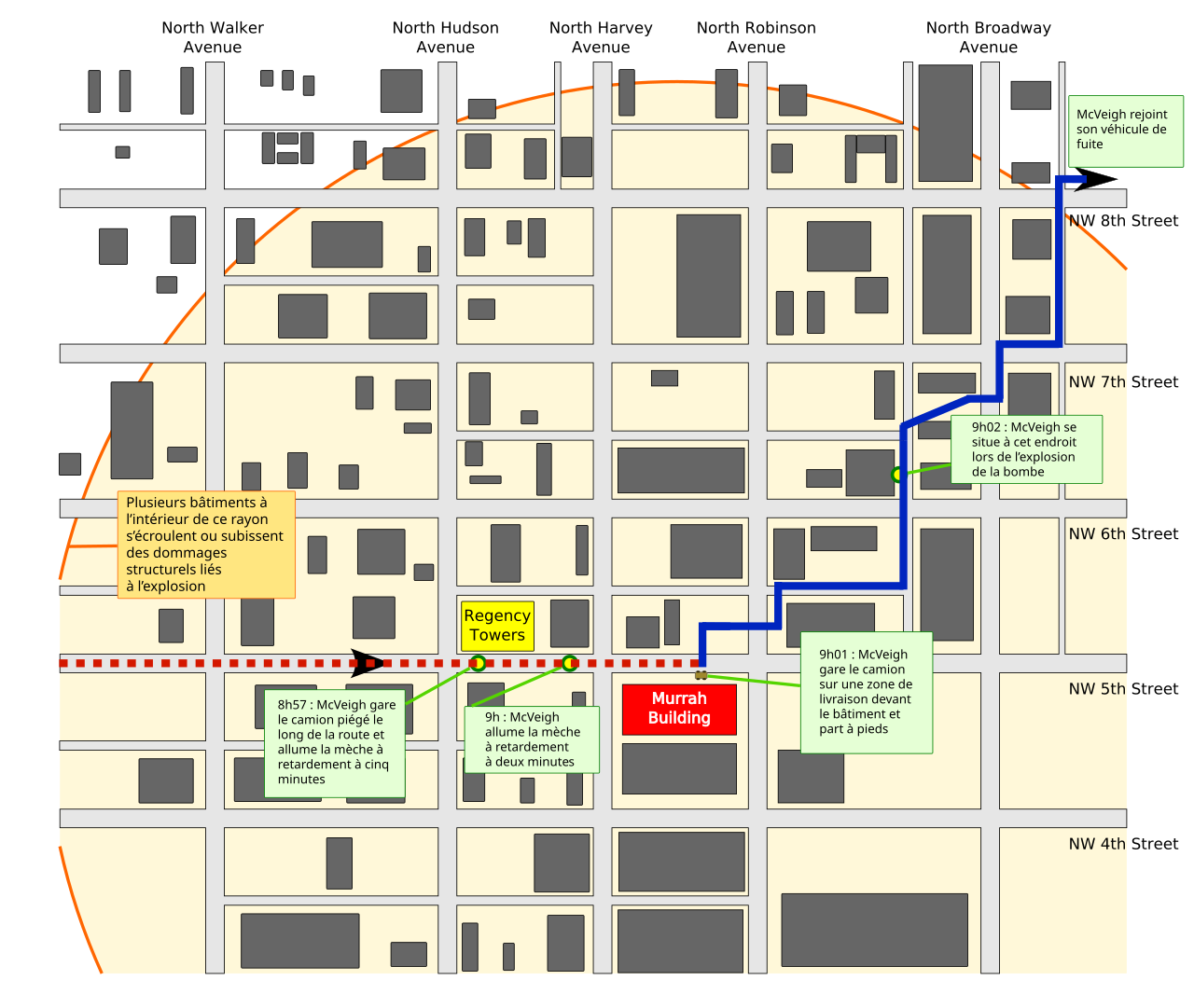
After leaving the military, McVeigh became increasingly radicalized by antigovernment beliefs. He fixated on two incidents that shaped his worldview: the 1993 Waco siege and the 1992 Ruby Ridge incident, both of which he blamed on federal agencies. He expressed particular hostility toward the Bureau of Alcohol, Tobacco, and Firearms and the Federal Bureau of Investigation, viewing their actions against private citizens as evidence of a tyrannical state. His ultimate goal was to inspire a broader revolution against the federal government, and he defended the use of violence as a legitimate tactic in that struggle. On April 19, 1995, he carried out the Oklahoma City bombing, which killed 167 people — including 19 children — and injured 684 others. The explosion destroyed roughly one-third of the Alfred P. Murrah Federal Building. A rescue worker was subsequently killed when falling debris struck her head, bringing the total death toll to 168. The attack stands as the deadliest act of domestic terrorism in American history.
Trial, Conviction, and Execution
McVeigh was arrested shortly after the bombing and faced a staggering list of charges: 160 state offenses and 11 federal offenses, the latter including the use of a weapon of mass destruction. In 1997, a jury found him guilty on every count, and he was sentenced to death. His execution by lethal injection took place on June 11, 2001, at the Federal Correctional Complex in Terre Haute, Indiana. The interval between the crime and his death — just over six years — and between sentencing and execution — just under four years — was considerably shorter than the typical wait for most inmates on death row. This compressed timeline was largely attributable to McVeigh's own refusal to pursue appeals or seek stays of execution. His death marked a historic milestone: he was the first person executed by the U.S. federal government since 1963, ending a nearly four-decade gap in federal capital punishment.
Gallery
Frequently Asked Questions
Who is Timothy McVeigh?
Timothy James McVeigh was an American domestic terrorist and former Gulf War veteran born in Lockport, New York, in 1968. He is best known for planning and executing the 1995 bombing of the Alfred P. Murrah Federal Building in Oklahoma City.
What is Timothy McVeigh known for?
He carried out the Oklahoma City bombing on April 19, 1995, killing 168 people and injuring more than 680 others. The attack destroyed roughly one-third of the federal building and remains the deadliest act of domestic terrorism in American history.
What motivated Timothy McVeigh?
McVeigh grew increasingly radicalized by antigovernment beliefs and held the federal government responsible for the 1993 Waco siege and the 1992 Ruby Ridge incident. He framed his attack as retribution against what he perceived as an oppressive federal authority.
How did Timothy McVeigh's story end?
After being convicted on all counts, McVeigh was sentenced to death and put to death by lethal injection on June 11, 2001, at the federal prison in Terre Haute, Indiana.
Why is Timothy McVeigh historically significant?
His actions made the Oklahoma City bombing the deadliest domestic terrorist attack in U.S. history and fundamentally reshaped the nation's approach to homeland security. The event also spurred major legislative and policy changes regarding federal building protection and the monitoring of extremist groups.
More in Criminals And Outlaws 1-24
Elsewhere in the Criminals And Outlaws universe
Spotted an error? Know more?
This is a living reference — every entry is fact-audited, and reader corrections feed straight into our audit queue. Suggest an edit · See this site's audit record